Tuesday, November 18, 2014
Video Analysis

Monday, November 17, 2014
Children's Literature and the Common Core

The implementation of the Common Core State Standards brought with it advocates as well as opponents, neither of which are shy in voicing their opinions. Jaclyn DeForge and Kathleen Porter-Magee are two of these people who openly share their thoughts on specific literacy aspects of the Common Core.
Although never explicitly stated by DeForge, it seems that both her and Porter-Magee support the use of complex texts in the classroom. However, DeForge has a problem with the list of titles the authors of the Common Core have recommended for utilization in the classroom. In "A More Diverse Appendix B," she states that many of the titles are old books, and by or about white people. In order to meet the criteria of the Common Core, teachers are using those books from the list in their classroom libraries and instruction, meaning that their classrooms focus little on diversity. When constructing a classroom library and selecting books for instruction, DeForge writes that "(1) Students should have an opportunity to to be exposed to both classic and contemporary literature as well as nonfiction texts, and (2) All students should have the opportunity to see themselves reflected back, as well as to be exposed to cultures that may differ from their own, in the literature and nonfiction texts we study." As a result, she constructed her own list of complex texts which reflect her thinking.
As an inhabitant of the United States, I support DeForge in what she has done. Our society is becoming more and more diverse as I write this sentence. School classrooms are filled with children of many races and backgrounds. In order for children to become accepting of people different than them, books should be introduced that celebrate the many races, cultures, religions, etc. Early intervention in this sense may limit ignorance and stereotyping in the future.
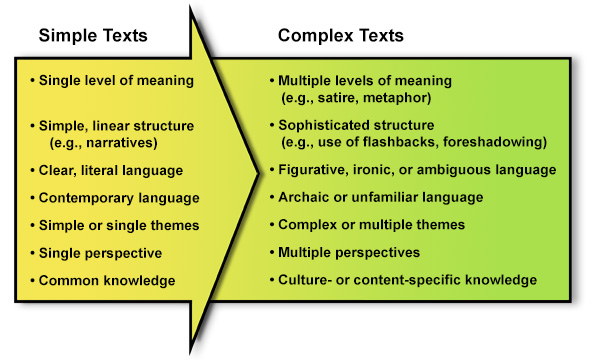
By analyzing the claims Porter-Magee has presented in her blog post, I have come to the conclusion that any student, no matter how poor they are at reading, can read the same books as the average student; all they need is a little extra help from the teacher. This means that all students in a particular grade could be reading the same book at the same time. The struggling readers would just be more dependent on the teacher than the average or above average readers.
Sunday, November 16, 2014
Original Poetry
Below is a poem that I wrote for my Honors 231 class last spring. We were given specific instructions to include an aspect of Native American life in the poem, so I chose to focus on the Native American belief of reciprocity. In terms of health, this means respecting the universe. If you were to do something like cut down a tree (nature was a huge part of Native American beliefs), the universe would retaliate by making you sick.
The Key to Staying Healthy
I
woke up as early as the sun one winter morning
And
knew right away the day would be boring.
So
much for the exciting plans that I had made
To
go with my friends to Savannah’s St. Patrick’s Day Parade.
While
they would be out having fun,
I’d
be lying in my bed having none.
With
no energy to move, all I could do is sleep,
And
dream about leprechauns and cloverleafs.
After
a week of bed rest and meds, I still felt the same
And
wondered how much longer it would take me to get back in the game.
I
thought I had been doing everything right,
But
this sickness was putting up a damn good fight.
I
then finally remembered what the Native Americans once said:
Reciprocity
is key; no need for meds.
In
this sacred world, respect all things,
And
you will not catch what sickness brings.
Now
I know I will never forget
To
treat everything like you would want to be treated,
And
sickness will always be defeated.
Tracing a Literature Standard
|
ANCHOR
STANDARD
CCSS.ELA-Literacy.CCRA.R.1
Read closely to determine what the text says explicitly and to make logical inferences from it; cite specific textual evidence when writing or speaking to support conclusions drawn from the text. |
||
|
GRADE
|
CCSS
|
INSTRUCTIONAL
SHIFT
2) Reading, writing, and speaking grounded in evidence from texts,
both literary and informational.
|
|
Grade 1
|
CCSS.ELA-Literacy.RL.1.1
Ask and answer questions about key details in a text.
Children in first grade should be able to use what they have read in
a particular text to ask and answer questions. Questions should be rooted in
the text, or text-dependent.
|
In first grade, students are working towards using what they have
read in a particular text to ask and answer questions. They are moving away
from random questions unrelated to the text to questions rooted in the text. This
can be taught by moving away from questions such as, “When is one time you
displayed an act of kindness? And more towards questions like, “What was the
result of *character’s name* act of kindness?”
|
|
Grade 2
|
CCSS.ELA-Literacy.RL.2.1
Ask and answer such questions as who, what, where, when, why, and how to demonstrate understanding of key details in a text.
Children in second grade should be able to use what they have read in
a particular text to ask and answer more specific questions. This is more
challenging than in first grade because the questions are more specific. Again,
the questions should be rooted in the text/text-dependent.
|
In second grade, students are moving into more specific
text-dependent questions. Questions asked about the text will most likely
begin with who, what where, when, why or
how. Just like in first grade, this
can be taught by moving away from those questions that ask how a situation
relates to a student’s life or that require an opinionated answer. The
answers to questions should be found in the text.
|
|
Grade 5
|
CCSS.ELA-Literacy.RL.5.1
Quote accurately from a text when explaining what the text says explicitly and when drawing inferences from the text.
Children in fifth grade should be able to specifically cite
information from the text when asking and answering questions from the text. They
should be able to use direct quotes from the text to support their questions/answers.
|
In fifth grade, students are now using the text to cite specific
sentences or passages in which answers to questions are found. They are
making logical inferences and citing specific textual evidence, which moves
them even closer to achieving the goals of the anchor standard. To teach
this, teachers should show students how to back up their answers with
specific textual evidence by going back in their text and finding the
specific sentence/passage on the specific page in which the answer is
explicitly stated.
|
For this assignment, we were instructed to trace a literature standard from the Common Core State Standards. I focused on anchor standard R.1, which says, "Read closely to determine what the text says explicitly and to make logical inferences from it; cite specific textual evidence when writing or speaking to support conclusions drawn from the text." I chose grades 1, 2, and 5 because those are three of the grades that I want to teach in the future. In the chart above, I wrote and explained the literacy standard in reading for each of the three grades. Then, I explained how the differences in the standards for each grade are affected by the second instructional shift, and how this can be taught addressing the second instructional shift. For me, the part dealing with the instructional shift was the most difficult. It was hard to relate the shift to the literacy standards, and I felt as if I didn't really know what I was doing, which I think is because this was one of my first encounters with the Common Core.
Saturday, November 15, 2014
The Writing Process: Step #4
"Whew!" I smile to myself and take a huge sigh of relief as I look down at my checklist, realizing that the final draft is the only step I have left to do in this particular writing assignment. What seemed so overwhelming in the beginning looks like a piece of cake now! The last step in my writing process is writing the final draft. If I have completed steps one, two, and three thoroughly, this part should be the easiest and least time-consuming out of the four.
 When beginning to make changes from my rough draft to transform it into my final draft, I sit in front of my computer with the rough draft on the screen and the marked up hard copy of my rough draft at my side. I use the paper copy as a reference when typing the information I edited. This makes it easy for me to see the before and after stages of my paper. When I am making the changes in order to create my final draft, I make the spelling and grammar corrections first because those are the least difficult. Then, I go back and fix my errors in content. Once I have made all the changes, I read over my paper out loud to myself as well as in my head. If I don't catch any errors after reading it both of those times, I happily hit the "save" button on Microsoft Word, and print out my paper.
The whole process normally takes me at least a week to complete, which is why I like to start my assignments early. However, sometimes procrastination gets the best of me, and I'm left with only a couple of days to complete an assignment. In those cases, I'm forced to combine the steps together. For instance, I often don't take the time to prewrite; I just begin writing the rough draft. Often, my revisions are only edits in structure, and not content. I have to rush through the assignment. All in all, start your papers early, and you won't regret it in the end.
The Writing Process: Step #3
The third step in my writing process involves revising. By this point, I think that the hardest parts of the writing process have already been completed because, personally, I love revising. It is my favorite part of the writing process. At the very least, I take the time to edit my own paper. If I have enough time, though, I make sure to have one (or maybe two or three) of my peers read it and comment on it. It's always good to have an extra pair of eyes look for errors and provide suggestions.
 Before I begin revising, I print out the rough draft on my paper. I'm old fashioned and like to mark up my paper with red pen instead of editing it on the computer. I feel like I catch more errors that way than I would when I edit on the computer. I look for errors in content and structure. I make sure I have addressed all of the major points the assignment requires. I look for unclear sentences and ask myself if I have stayed on topic. Revising is more than just correcting spelling and grammar mistakes; it's really being critical of your writing and asking yourself how you can make it better.
When revising, I make sure to read through my paper more than once. It's always possible that I could've missed some crucial mistake the first time around. Normally, I look for errors only in the structure of my paper the first time, unless there are content errors that really jump out at me. The second, third, fourth, etc. times, I focus on the content, asking myself various questions: (1) Did I explain my topic thoroughly enough? (2) Did I provide enough evidence to back up my argument? (3) Will my readers understand what I'm saying, or do I need to elaborate more?
After I have stained my rough draft with red pen, I put the paper aside again for a short break. Because the writing assignment is now almost completed, I normally start making those changes on the computer to create my final draft quickly after I have finished revising. I've made it so far through the assignment, so I am eager to be done with it. Stay tuned to hear how my writing process concludes!
Saturday, November 8, 2014
The Writing Process: Step #2
 After a hopefully long, relaxing break from a writing assignment, it's time to get back on the grind and proceed forward through the writing process. My next step involves me writing the rough draft. If I include as much detail as possible in my outline, this step should take only a short amount of time.
When writing a paper, no matter what kind of paper it is, I always have to begin with the introduction. I can't jump from one part of the paper to another, and I couldn't tell you why. I guess I'm just such a structured and orderly person that I can't go out of order doing anything.
For me, the introduction typically takes the longest amount of time to write. I think and think about how to craft it in a way that is both interesting and engaging. I don't want my readers to want to put down my paper after reading the introduction; I want them to want to read more. The body paragraphs are fairly easy because I have already written down in my outline all the information I want to include. Like the introduction, the conclusion is also difficult for me. I have to find a way to sum up what I've elaborated on in my body paragraphs without restating what I've already said. I also try to end with a question or statement that gets my readers thinking.
Once I type the punctuation mark that ends the last sentence of my conclusion, I save and close the document, and take a break before I come back to it to revise it. When you take a break after writing your rough draft, it's likely you'll open it later with new ideas that you wouldn't have had if you revised it right away. Additionally, taking a break also gives you time to have your peers edit it if you so wish. These people can contribute even more ideas. All in all, I believe that the sooner you start a paper, the better it will be.
Subscribe to:
Posts (Atom)